understanding Weirs in Fluid Mechanics
Weirs are one of the simplest and most practical tools in open channel flow. In many rural places such as rural irrigation systems, remote streams, small treatment plants; there’s no budget for sensors or flow meters. A weir gives accurate flow data using gravity and geometry.
What is a Weir?
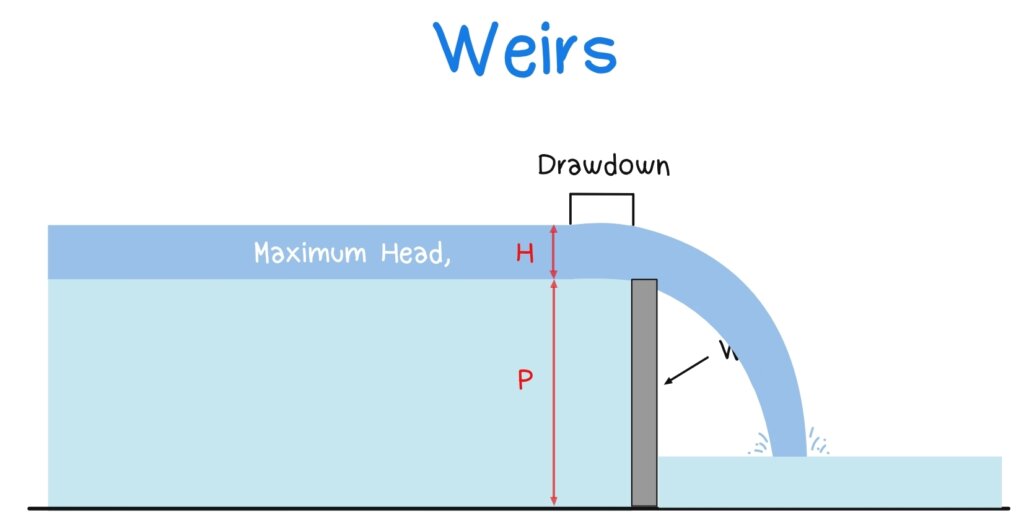
A weir is a low dam or barrier built across a river or channel to control water flow. It forces water to pass over or through a specific opening, creating predictable flow patterns that engineers can measure and manage.
Think of a weir like a spillway on a bathtub. When you fill your tub with water, once it reaches a certain level, it spills over the edge at a controlled rate. A weir works the same way.
It’s a controlled spill point that keeps water from flowing freely and unpredictably downstream. The difference is their height and purpose.
Dams are massive structures to hold the flow and act as a storage for large reservoirs.
Weirs are smaller but it acts as a device to determine the flow rate and water level.
Basic Concepts of Weir
Head (H)
Vertical Distance from water surface to weir crest.
Discharge (Q)
Volume of fluid flowing per unit of time.
Types of Weir
Rectangular Weir
The simplest and most common type. Water flows over a rectangular opening. Easy to construct and easy to calculate flow through.
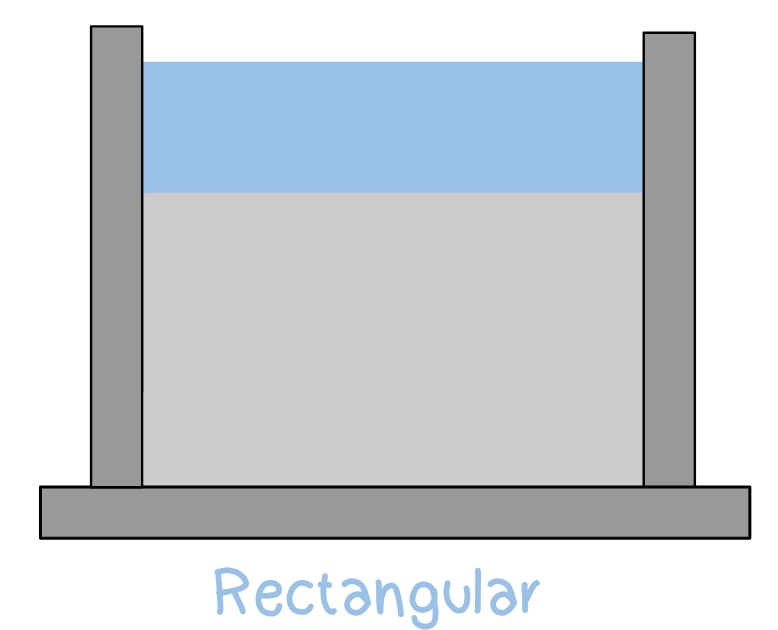
- Straight notch with horizontal crest
- Best for large, steady flows
![\[Q=\frac{2}{3}C \sqrt{2g}LH^{3/2}\]](https://civilengghub.com/wp-content/ql-cache/quicklatex.com-e942b6dd3117e8ea3834deebcc9e78af_l3.png "Rendered by QuickLaTeX.com")
where:
Q – discharge or flow rate
C – coefficient of discharge
b – width of the weir opening
g – gravitational acceleration
H – head or the height of water above the weir crest
Triangular Weir (V-notch)
Water flows through a V-shaped notch cut into the weir. These are extremely accurate for measuring small flows because the V shape creates a wider opening for larger flows, and narrower opening for smaller flows.
![\[Q=\frac{8}{15}C\sqrt{2g}tan \frac{\theta}{2}H^{5/2}\]](https://civilengghub.com/wp-content/ql-cache/quicklatex.com-dee308fd3006938a0862270e208f999b_l3.png "Rendered by QuickLaTeX.com")
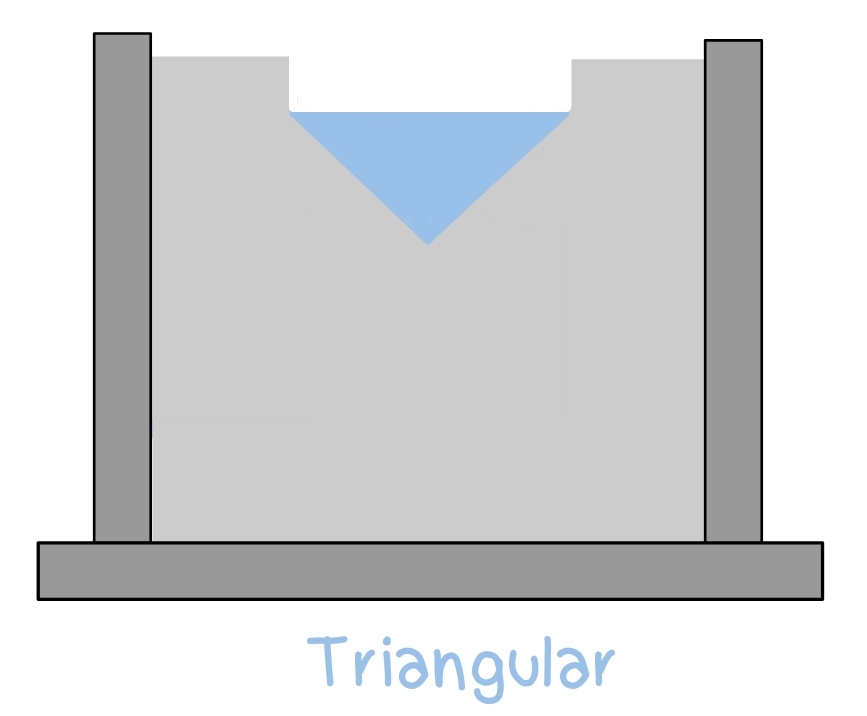
- V-shape opening (usually 90 degrees)
- More accurate for low flows
Trapezoidal Weir (Cipolleti)

![\[Q=\frac{2}{3}C\sqrt{2g}LH^{3/2}+\frac{8}{15}C\sqrt{2g}tan \frac{\theta}{2}H^{5/2}\]](https://civilengghub.com/wp-content/ql-cache/quicklatex.com-bed8c09ed843ccfd93c88b6ed8cac1fa_l3.png "Rendered by QuickLaTeX.com")
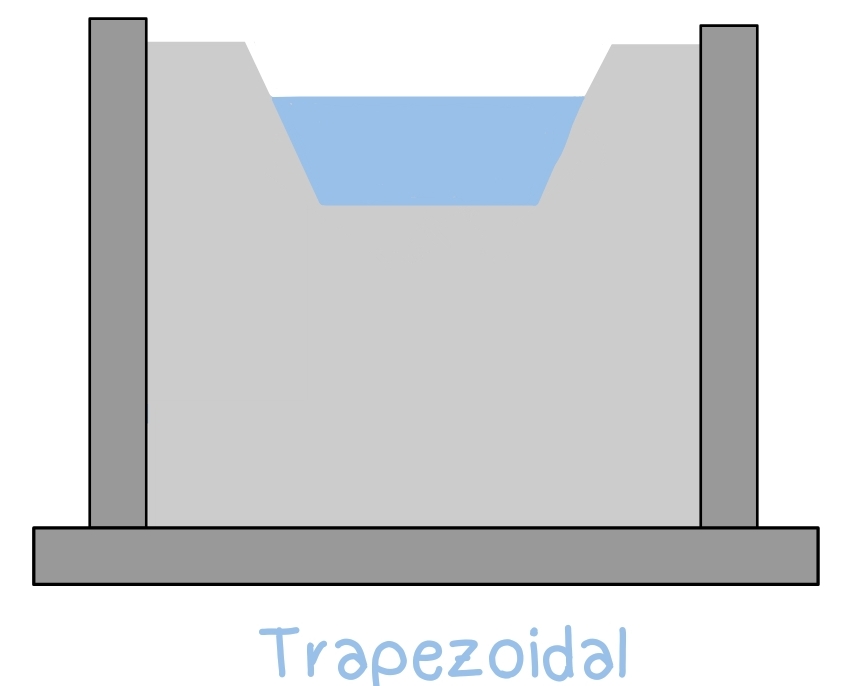
- Combines advantages of rectangular and v-notch
Design Consideration
1. Choose the right shape.
| Rectangular | Best for moderate to high flows where a simple structure suffices |
| V-notch | Ideal for low flows or when the channel is shallow |
| Trapezoidal | Useful when the flow regime spans from low to high and a single weir can cover the entire range. |
2. Determine the discharge coefficient Cd
Empirical studies (e.g., Chow, Maidment & Mays, 2007) suggest Cd values close to 0.62 for rectangular weirs with sharp crests. Field calibration, where feasible, can refine this value.
3. Account for upstream conditions
The weir assumes a rectangular channel cross‑section and that the water surface upstream is flat. In practice, channel roughness, sediment, and upstream flow variations introduce error; measuring the upstream water level with a simple staff gauge can help mitigate this.
4. Material Selection
Concrete is the most common choice, but in some remote areas timber or even packed earth can be used but the weir will not be for long-term.
5. Maintenance
Periodic inspection is needed to clear the sediments and trash that may accumulate at the crest.
Conclusion:
A weir is a simple yet useful solution born from 19th-century hydraulic research, that’s why it is still relevant today. For civil engineers working on rural irrigation, remote streams, and small treatment plants, a well-designed delivers reliable flow data without the overhead of modern sensors. Many projects before have shown that when budgets are tight but the need for accurate water management is high, a simple weir can be a game‑changer.
References:
Chow, C. T., Maidment, R. H., & Mays, L. G. (2007). Applied Hydrology (5th ed.). McGraw‑Hill.
Hillhouse, G. (2019, March 9). What is a weir? Practical Engineering. https://practical.engineering/blog/2019/3/9/what-is-a-weir
📍This post is part of FLUID MECHANICS COMPLETE Lessons. Also, if you want to avail the complete Cheat Sheet just click the “image” below.