Bearing Capacity of Soil
What is Bearing Capacity?
Bearing capacity is the maximum pressure that soil can sustain under a foundation without undergoing shear failure. It represents the soil’s ability to support the loads transmitted from the superstructure through the foundation system. The bearing pressure is the contact force per unit area along the bottom of the foundation, making it a critical parameter in foundation design.
Foundation Types and Classification
Shallow Foundations
According to Terzaghi (1943), shallow foundations should have a depth-to-width ratio (D/B) ≤ 1. However, later researchers have expanded this criterion, allowing D/B ratios up to 3-4. Generally, shallow foundations have depths less than 3 meters and are the most economical option when suitable bearing soils are available near the surface.
Types of Shallow Foundations
Isolated Footings
- Support individual columns or piers
- Most common type for building foundations
- Square, rectangular, or circular shapes
- Cost-effective for moderate loads
Combined Footings
- Support two or more columns
- Used when columns are closely spaced
- Helpful when property line restrictions exist
- Can be rectangular or trapezoidal
Strip Footings
- Continuous foundations under walls
- Distribute loads along their length
- Common in residential construction
- Suitable for uniform loading conditions
Mat/Raft Footings
- Cover the entire building area
- Used for heavy structures or poor soil conditions
- Distribute loads over large areas
- Reduce differential settlements
Deep Foundations
When suitable bearing soils are not available at shallow depths, deep foundations transfer loads to stronger soil layers or bedrock at greater depths. These foundations are essential when shallow foundation solutions are not viable due to soil conditions or loading requirements.
Types of Shear Failure in Foundations
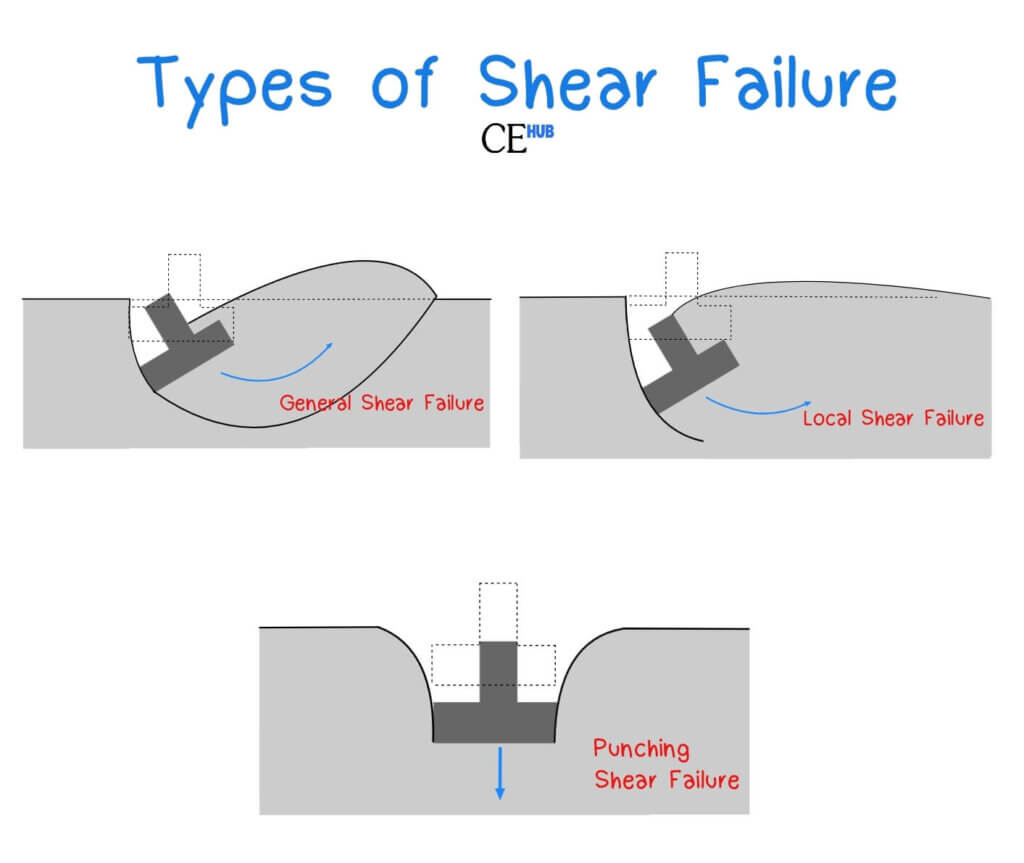
General Shear Failure
Characteristics:
- Fully developed failure plane extending from foundation edge to ground surface
- Sudden or catastrophic failure with distinct failure pattern
- Significant bulging of ground surface adjacent to the foundation
- Most common type of shear failure in engineering practice
Occurrence:
- Strong, dense soils with good shearing resistance
- Well-compacted granular soils
- Overconsolidated clay soils
- Provides clear indication of ultimate bearing capacity
Local Shear Failure
\[ c’=\frac{2}{3} c\]
Characteristics:
- Failure plane not completely defined or developed
- Failure occurs with sudden jerks rather than smooth progression
- Small amount of ground surface bulging may be observed
- Intermediate failure mode between general and punching shear
Occurrence:
- Medium dense sands with moderate compaction
- Normally consolidated clays with medium consistency
- Soils with intermediate strength characteristics
- Transition zone behavior in soil strength
Punching Shear Failure
Characteristics:
- Foundation sinks into soil like a punch through the ground
- Failure surface does not extend to the ground surface
- Minimal ground surface disturbance or bulging
- Continuous settlement without clear failure indication
Occurrence:
- Very loose sands with low relative density
- Weak clays with low undrained shear strength
- Highly compressible soils
- Requires careful monitoring as failure is less obvious
Bearing Capacity Definitions and Terminology
Ultimate Bearing Capacity (qu)
The ultimate bearing capacity is the gross pressure at the base of the foundation at which the soil fails in shear. This represents the maximum pressure the soil can sustain before undergoing shear failure. It is determined through theoretical analysis, laboratory testing, or field testing methods.
Net Ultimate Bearing Capacity
The net ultimate bearing capacity is the net increase in pressure at the base of the foundation that causes shear failure of the soil. This represents the structural load that can be carried by the soil without undergoing shear failure, accounting for the existing overburden pressure.
\[q_{nu}=q_u-\gamma\timesD_f\]
Where:
- qu = ultimate bearing capacity
- γ = unit weight of soil
- D = depth of foundation
Net Safe Bearing Capacity
The net safe bearing capacity is the net pressure which can safely be applied to the soil considering only shear failure. This value incorporates a factor of safety against shear failure but does not consider settlement limitations.
\[q_{ns}=\frac{q_{nu}}{FOS}\]
Gross Safe Bearing Capacity (qgs)
The gross safe bearing capacity is the maximum gross pressure which soil can carry safely without shear failure. This includes both the structural load and the weight of soil above the foundation level.
\[q_{s}=\frac{q_{nu}}{FOS}+\gamma\timesD_f\]
Net Allowable Bearing Capacity (qna)
The net allowable bearing capacity is the maximum pressure which the soil can carry safely without undergoing shear failure OR excessive settlement. This is the governing value for foundation design as it considers both strength and serviceability requirements.
This value is typically the lesser of:
- Net safe bearing capacity (based on shear failure)
- Bearing capacity based on allowable settlement criteria
Terzaghi’s Bearing Capacity Theory
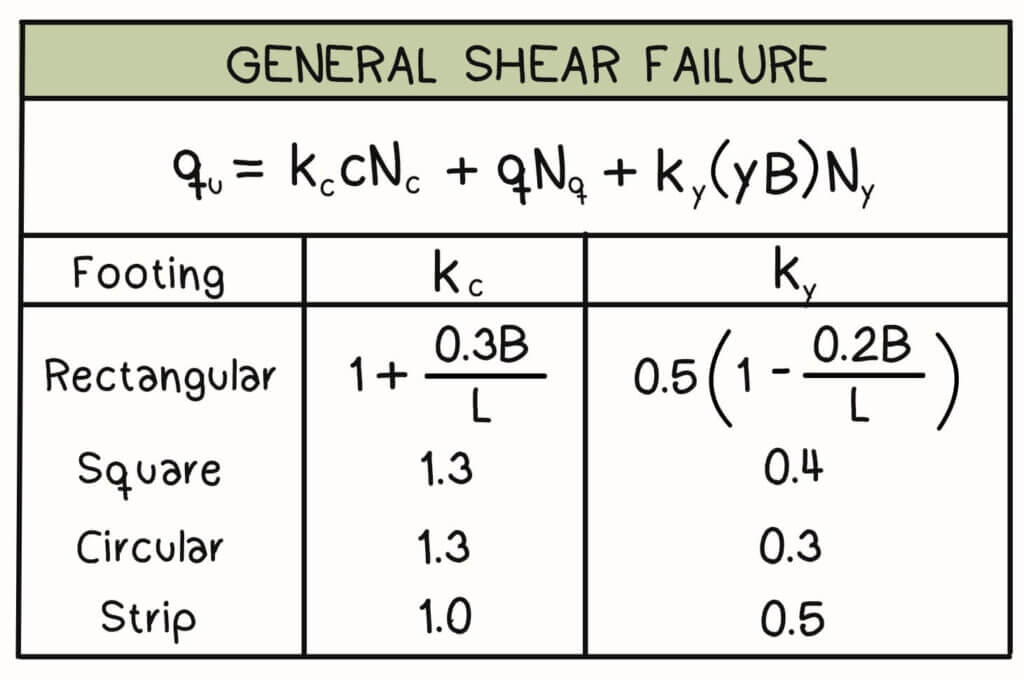
GENERAL FORMULA:
\[q_{ult}=k_ccN_c+K_qqN_q+k_{\gamma}(\gamma’B)N_{\gamma}\]
SQUARE:
\[q_u=cN_c+\gammaDN_q+0.5\gammaBN_{\gamma}\]
where:
$\gamma’$=effective unit weight of the soil
$B$=width of the footing
$N_$=factor of unit weight of soil
$N_$=factor of soil cohesion
$N_$factor of overburden pressure
$q$=effective stress
$k_ c,k_q,k_{\gamma}=constants
General Shear Failure
| Strip Footing | $q_{ult}=cN_ c +qN_q+0.5\gammaB N_{\gamma}$ |
| Square Footing | $q_{ult}=1.3 cN_ c+qN_q+0.4\gammaB N_\{gamma}$ |
| Circular Footing | $q_{ult}=1.3 cN_ c+qN_q+0.3\gammaB N_{\gamma}$ |
Here’s the Table so that it’s easier for you to memorize:
References:
Holtz, R. D., & Kovacs, W. D. (1981). An introduction to geotechnical engineering. Prentice
Hall.Das, B. M. (2013). Fundamentals of geotechnical engineering. Cengage Learning