Understanding the Bernoulli Equation In Fluid Mechanics
What is Bernoulli’s Equation?
DEFINITION
The Bernoulli Equation states that in a steady, incompressible, and frictionless flow, the total mechanical energy of the fluid remains constant along a streamline.
It is based on the Law Conservation of Energy where it states that “Energy cannot be created or destroyed—only transferred.“
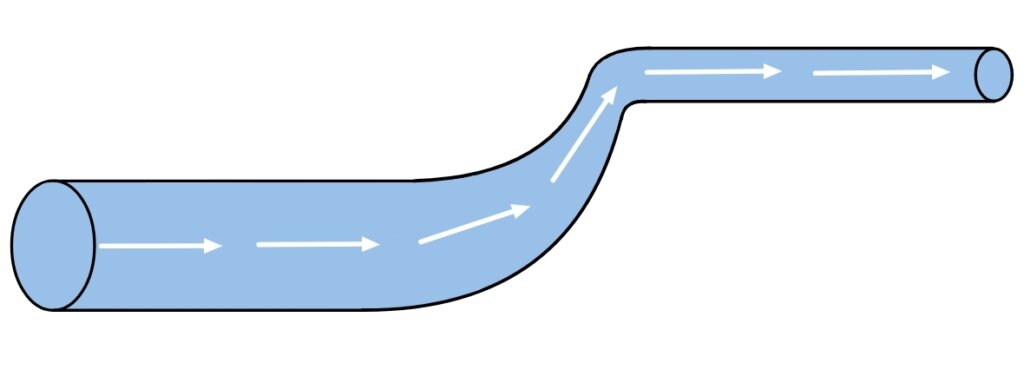
In essence, Bernoulli’s Equation describes how pressure energy, kinetic energy, and potential energy interact within a flowing fluid system. As fluid moves through different sections of a pipe or channel, these energy forms convert into one another while maintaining a constant total energy (assuming no losses).
Why this Matter to you as a Beginner
Think of Bernoulli’s Equation as the “golden rule” of fluid mechanics, it’s one of foundation for understanding energy trade-offs in any fluid system. Here’s what makes it so powerful:
Understanding the Bernoulli Equation In Fluid Mechanics is essential for anyone studying fluid dynamics.
It Explains the Pressure-Velocity Relationship:
- When water speeds up (high velocity), pressure drops
- When water slows down (low velocity), pressure rises
It Connects Three Types of Energy:
- Pressure energy (P/γ): The force pushing water through pipes
- Kinetic energy (v²/2g): The motion of water flowing
- Potential energy (z): The height advantage of the elevated tank
So in this topic, I’ll walk you through in of the most fundamental topic of Fluid Mechanics.
Historical Context
The equation is named after Swiss mathematician Daniel Bernoulli, who published it in his 1738 work “Hydrodynamica.” However, it was later derived more rigorously by Leonhard Euler using his equations of motion. This principle has since become indispensable in hydraulic engineering, aerodynamics, and various fluid mechanics applications.
Background Derivation
Bernoulli’s equation is derived from Euler’s Equation of Motion along a streamline under a steady incompressible flow.
![\[\frac{dP}{\rho} + gdz+ \upsilondv = 0 \]](https://civilengghub.com/wp-content/ql-cache/quicklatex.com-4c77dd6061b4fc54422ada227e3cd825_l3.png "Rendered by QuickLaTeX.com")
Where: = Density of the fluid (kg/m³) = Change in elevation (m) = Change in velocity (m/s) = Change in pressure (N/m²)
Step 1: Integrate the Equation
![\[\int\left(\frac{dP}{\rho}+gdz+vdv=0\right)\]](https://civilengghub.com/wp-content/ql-cache/quicklatex.com-b3ea876bcf895d889baa48b9c80a8493_l3.png "Rendered by QuickLaTeX.com")
This yields:
![\[\frac{P}{\rho}+gz+\frac{v^2}{2}=C\]](https://civilengghub.com/wp-content/ql-cache/quicklatex.com-f4afcb17eff9f0e6368751d7f79867fc_l3.png "Rendered by QuickLaTeX.com")
Step 2: Divide by Gravitational Acceleration (g)
![\[\frac{P}{\rho g}+z+\frac{v^2}{2g}=C\]](https://civilengghub.com/wp-content/ql-cache/quicklatex.com-8bdd3e7184419e436b5e980c29924644_l3.png "Rendered by QuickLaTeX.com")
Since specific weight γ = ρg, and express in terms of head. We can rewrite this as:
![\[\frac{P}{\gamma}+z+\frac{v^2}{2g}=C\]](https://civilengghub.com/wp-content/ql-cache/quicklatex.com-8bda70998789b67cd3f025ba375e5674_l3.png "Rendered by QuickLaTeX.com")
This is BERNOULLI’S EQUATION!
Bernoulli’s Equation Formula
The general form of the Bernoulli Equation is:
![\[\frac{P}{\gamma}+\frac{v^2}{2g}+z=H\]](https://civilengghub.com/wp-content/ql-cache/quicklatex.com-b827e8f41da356d05aecc436ca240aef_l3.png "Rendered by QuickLaTeX.com")
Where:
P – Pressure (Pa or N/m²) – Specific weight of fluid N/m³
v – Flow velocity (m/s)
z – Elevation above a datum (m)
H – Total head (m)
This equation expresses energy in meters of fluid (called “head”), which makes it easy to visualize using a piezometer or manometer.
Key Components of the Equation
| Term | Name | Physical Meaning |
|---|---|---|
| Pressure Head | Energy due to fluid pressure |
| Velocity Head | Energy due to motion (kinetic) |
| Elevation Head | Gravitational potential energy |
| Total Head | Total mechanical energy of the fluid |
![\[\frac{P}{\gamma}\]](https://civilengghub.com/wp-content/ql-cache/quicklatex.com-44ae5385f76a46cb71e3f5013ced315f_l3.png "Rendered by QuickLaTeX.com")
![\[\frac{v^2}{2g}\]](https://civilengghub.com/wp-content/ql-cache/quicklatex.com-12569293c745c5bb41e06e8885510e16_l3.png "Rendered by QuickLaTeX.com")
![\[z\]](https://civilengghub.com/wp-content/ql-cache/quicklatex.com-b1af7d27f46cf824df41bdbffa1b6610_l3.png "Rendered by QuickLaTeX.com")
![\[H\]](https://civilengghub.com/wp-content/ql-cache/quicklatex.com-d6b731a6ea87449af8bd93eebc19a169_l3.png "Rendered by QuickLaTeX.com")
Modified Bernoulli Equation (With Head Loss and Pumps)
In real-world engineering application, friction exists. Therefore, it is important to consider this in the overall system by modifying the equation.
![\[\frac{P_1}{\gamma}+\frac{v_1^2}{2g}+z_1+h_p=\frac{P_2}{\gamma}+\frac{v_2^2}{2g}+z_2+h_L+h_t\]](https://civilengghub.com/wp-content/ql-cache/quicklatex.com-9f2da21e3471d3177ff18950e89451bf_l3.png "Rendered by QuickLaTeX.com")
| Term | Description |
|---|---|
| Head loss due to friction and fittings |
| Head added by a pump |
| | Head extracted by a turbine |
![\[h_L\]](https://civilengghub.com/wp-content/ql-cache/quicklatex.com-2471e683a4394c5c8b938678a2fc50b6_l3.png "Rendered by QuickLaTeX.com")
![\[h_p\]](https://civilengghub.com/wp-content/ql-cache/quicklatex.com-1ea7ca6a55f123dda98305652f7fc313_l3.png "Rendered by QuickLaTeX.com")
![\[h_t\]](https://civilengghub.com/wp-content/ql-cache/quicklatex.com-50385a7b2cc536e51eaf09dfd252df06_l3.png "Rendered by QuickLaTeX.com")
If you want to know more about pumps and turbines in bernoulli, check out the link.
Example : Flow between two points in a Pipe
Consider a flow between two points in a pipe. At Point 1, the pressure is 400 kPa, the velocity is 2.5 m/s, and the elevation is 12 meters. At Point 2, the velocity is 3 m/s, the elevation is 8 meters, and the pressure is unknown. There is no pump in the system, and the head loss is 2 meters. The specific weight of the fluid is given as γ = 9810 N/m³. Find pressure at point 2.
Write Bernoulli with head loss







Bernoulli’s Equation with Correction Factor
Bernoulli’s Equation is often taught in school based on ideal fluids but if you want to major in Water Resources Engineering, it is important to know that water isn’t always idealized. In real-world engineering, the flow will be uniform (usually taught in school), laminar, and turbulent. Thererfore, I will guide you to ensure that your analysis matches the real behavioural of fluids in real-world engineering by modifying the Bernoulli Equation once again using a correction factor.
A brief summary of the Modified Bernoulli Equation with correction factor:
Where α (alpha) is the kinetic energy correction factor (also called the Coriolis coefficient).
Definition of α
![\[alpha=\frac{\int v^3 dA}{V^3A}\]](https://civilengghub.com/wp-content/ql-cache/quicklatex.com-c73f0829b61183fb8ddb0f99ac440249_l3.png "Rendered by QuickLaTeX.com")
Where:
- v = local velocity at a point
- V = average velocity
- A = cross-sectional area
Why Correction Factors
In laminar flow, velocity is highest at the center and zero at the walls (parabolic profile). In turbulent flow, the profile is flatter but still non-uniform. The kinetic energy of the actual non-uniform flow is different from that calculated using average velocity.
Typical Values of α:
| Flow Type | Velocity Profile | α\alphaα |
|---|---|---|
| Ideal (uniform) flow | Flat profile | 1.0 |
| Laminar pipe flow | Parabolic profile | 2.0 |
| Turbulent pipe flow | Almost flat profile | 1.05–1.15 |
Practical Applications in Civil Engineering
Bernoulli’s Equation is not just theoretical—it’s applied daily in various civil engineering disciplines.
1. Water Distribution Systems
Engineers use Bernoulli’s equation to:
- Design pipe networks with adequate pressure
- Size pumps for water treatment plants
- Analyze pressure drops in distribution mains
- Determine optimal pipe diameters
2. Open Channel Hydraulics
Applications include:
- Designing spillways and weirs
- Analyzing flow over dams
- Calculating discharge through sluice gates
- Evaluating energy dissipation in hydraulic jumps
3. Flow Measurement
Bernoulli’s principle enables flow measurement devices:
- Venturi meters: Measure flow rate by pressure difference
- Orifice plates: Simple flow measurement in pipes
- Pitot tubes: Measure local velocity in streams or pipes
Summary and Key Takeaways
The Bernoulli Equation is a cornerstone of fluid mechanics and an indispensable tool for civil engineers. Here are the essential points to remember:
- Core Principle: Total mechanical energy (pressure + kinetic + potential) remains constant along a streamline in ideal flow
- Three Forms of Energy:
- Pressure head: P/γ
- Velocity head: v²/2g
- Elevation head: z
- Real-World Modifications:
- Add head loss (h_L) for friction
- Add pump head (h_p) for energy input
- Add turbine head (h_t) for energy extraction
- Correction Factors: Use α for non-uniform velocity profiles, especially in laminar flow and open channels
Conclusion
The Bernoulli Equation in Fluid Mechanics plays a crucial role in Civil Engineering applications. It provides a fundamental understanding of fluid flow behavior and pressure distribution in various systems. In the real world, engineers frequently rely on the Bernoulli Equation to analyze and design hydraulic systems and structures efficiently but it is also important to know various factors affecting the behavior of Fluids.
References:
Liu, C. (2013). Schaum’s Outline of Fluid Mechanics and Hydraulics, 4th Edition. McGraw Hill Professional.
📍This post is part of FLUID MECHANICS COMPLETE Lessons. Also, if you want to avail the complete fluid mechanics formulas just click the image below.