What is Geotechnical Engineering?
Geotechnical Engineering in Civil Engineering is taught in schools for us to understand how soil and rock behave under various loading conditions and how they interact with structures. For engineering students, it’s one of the fundamental subjects you’re introduced to, as it forms the foundation, a safe and stable construction. Knowledge about soil mechanics and foundation design is essential for civil, structural, mining, and environmental engineering.
BY DEFINITION
Geotechnical Engineering is a branch of civil engineering that deals with the behavior of earth materials, including soil and rock, and their interaction with structures.
In the context of Geotechnical Engineering, understanding soil behavior is crucial for designing foundations, retaining structures, slopes, and earthworks. This roadmap of Geotechnical Engineering will guide you to cover all the necessary topics in the course.
Fundamental Soil Properties and Classification
Ch1: Basic Properties of Soil
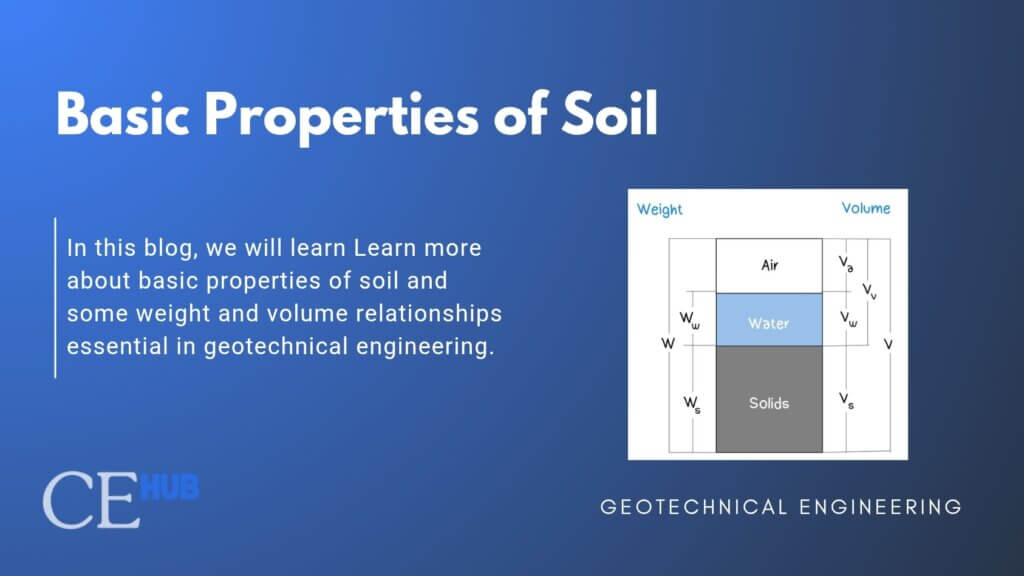
- Soil is a natural aggregate of mineral particles, organic matter, water, and air.
- Three-phase system: Soil consists of solid particles, water (liquid), and air (gas).
- Key Properties:
- Void ratio (e): Ratio of volume of voids to volume of solids
- Porosity (n): Ratio of volume of voids to total volume
- Water content (w): Ratio of mass of water to mass of solids
- Degree of saturation (S): Percentage of voids filled with water
- Unit weight (γ): Weight per unit volume
- Specific gravity (Gs): Ratio of unit weight of solids to unit weight of water
Ch2: Atterberg Limits
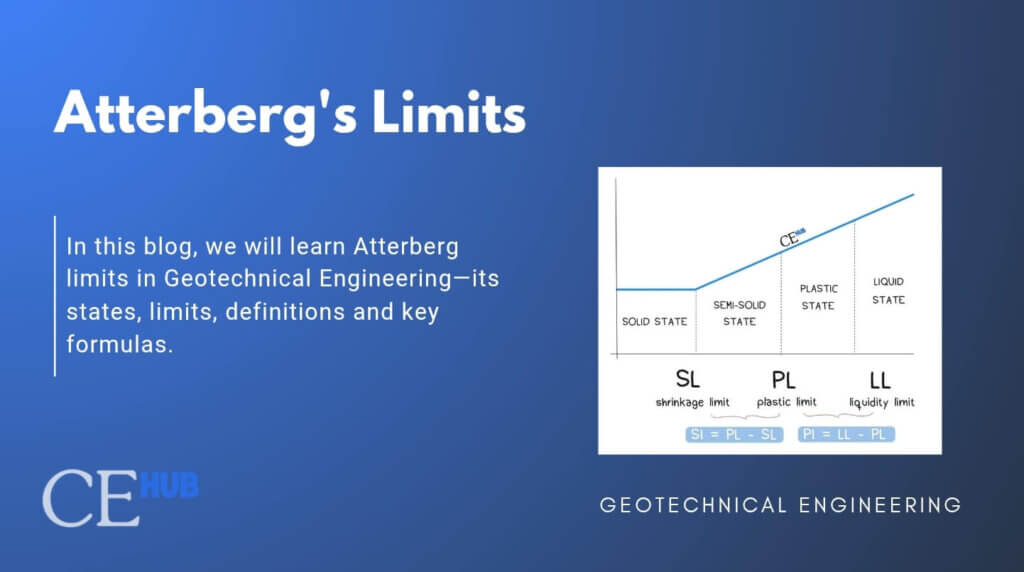
- Atterberg Limits define the moisture contents at which fine-grained soils transition between different states of consistency.
- Liquid Limit (LL): Water content at which soil behaves as a liquid.
- Plastic Limit (PL): Water content at which soil begins to crumble when rolled into threads.
- Shrinkage Limit (SL): Water content below which further loss of moisture does not cause volume reduction.
- Plasticity Index (PI): Difference between liquid limit and plastic limit (PI = LL – PL). Indicates the range of water content over which soil remains plastic.
- Liquidity Index (LI): Indicates the current consistency of soil relative to its plastic and liquid limits.
Ch3: Soil Classification
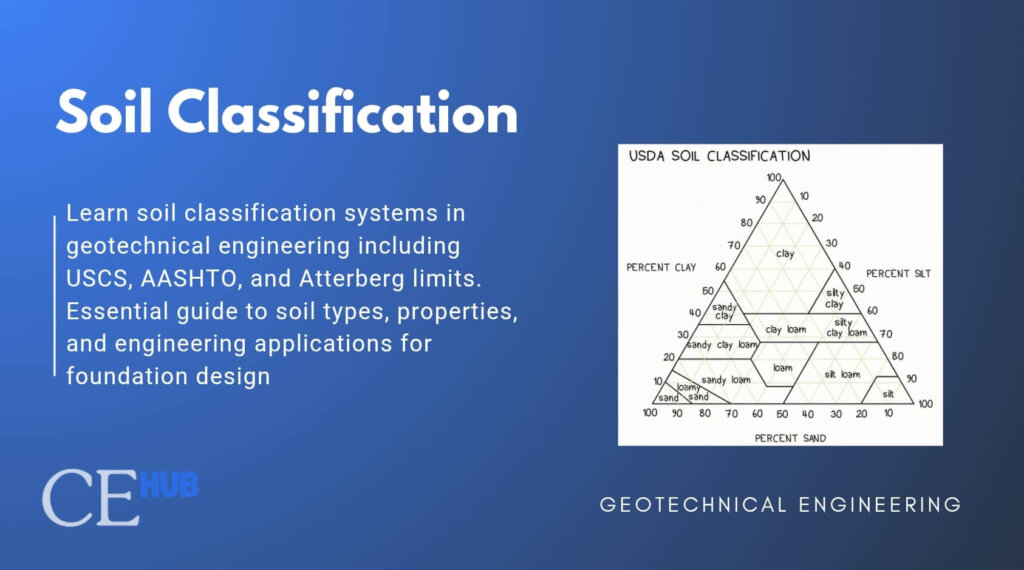
Soil classification systems organize soils into groups with similar engineering properties.
- Unified Soil Classification System (USCS): Based on particle size distribution and plasticity characteristics. Uses group symbols like GW, SW, CL, CH.
- AASHTO Classification System: Used primarily for highway engineering. Classifies soils into groups A-1 through A-7.
- Grain Size Distribution: Determined through sieve analysis for coarse-grained soils and hydrometer analysis for fine-grained soils.
- Coefficient of Uniformity (Cu) and Coefficient of Curvature (Cc): Describe the gradation of soil.
Soil Hydraulics
Ch 4: Permeability
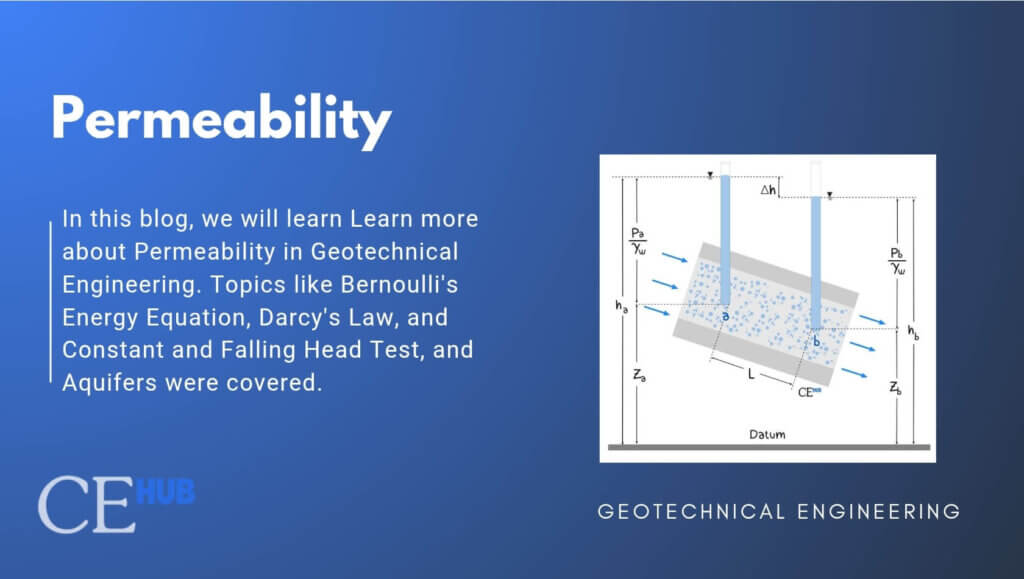
- Permeability is the ability of soil to allow water to flow through its pores.
- Darcy’s Law: The fundamental equation governing flow through porous media:
![\[q =kia\]](https://civilengghub.com/wp-content/ql-cache/quicklatex.com-988f9c18dcc2904ebda088d079e45546_l3.png "Rendered by QuickLaTeX.com")
where:
- q = discharge
- k = coefficient of permeability (hydraulic conductivity)
- i = hydraulic gradient
- A = cross-sectional area
Ch5: Seepage
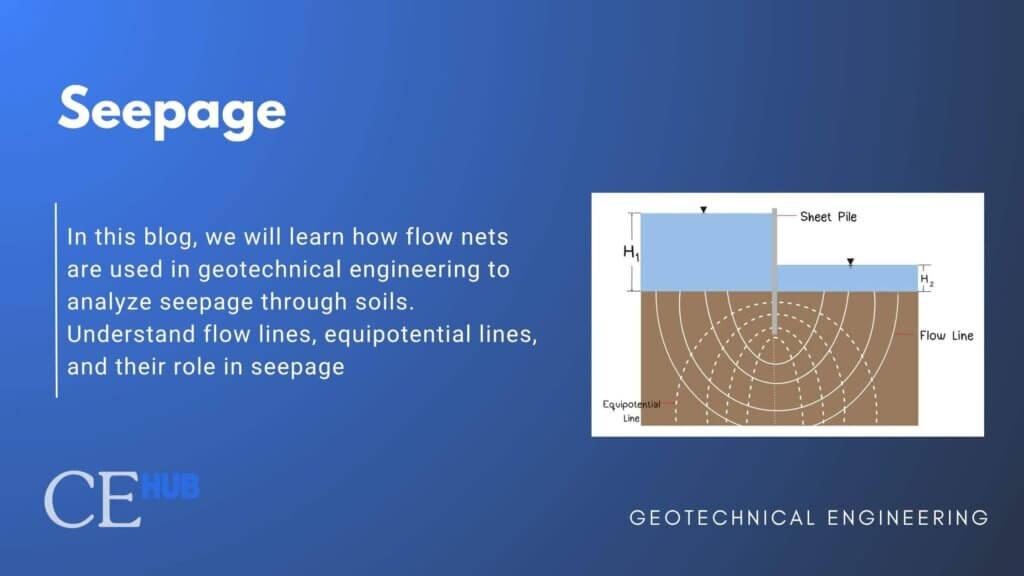
- Seepage is the flow of water through soil under a hydraulic gradient.
- Flow nets: Graphical representation of seepage using flow lines and equipotential lines. Used to analyze seepage beneath dams, sheet pile walls, and other hydraulic structures.
- Seepage force: The force exerted by flowing water on soil particles.
Soil Mechanics and Behavior
Ch 6: Compressibility of Soil
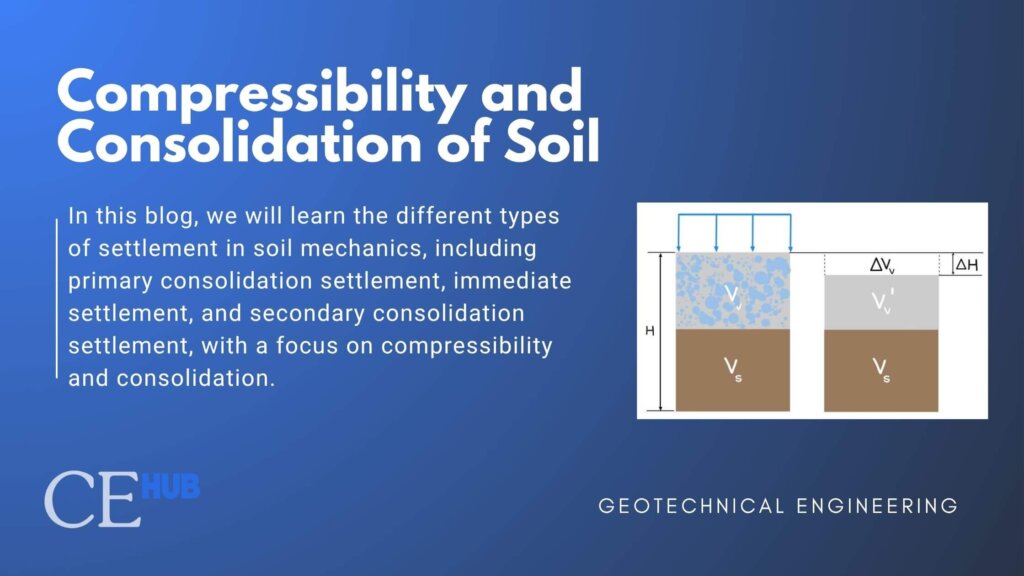
- Compressibility is the tendency of soil to decrease in volume when subjected to load.
- Consolidation: Time-dependent reduction in volume of saturated soil due to expulsion of water from voids.
- Primary consolidation: Volume change due to expulsion of pore water under constant effective stress.
- Secondary compression: Volume change that continues after primary consolidation, due to adjustment of soil structure.
- Compression Index (Cc): Slope of the virgin compression curve in e-log p plot.
Ch7: Lateral Earth Pressure
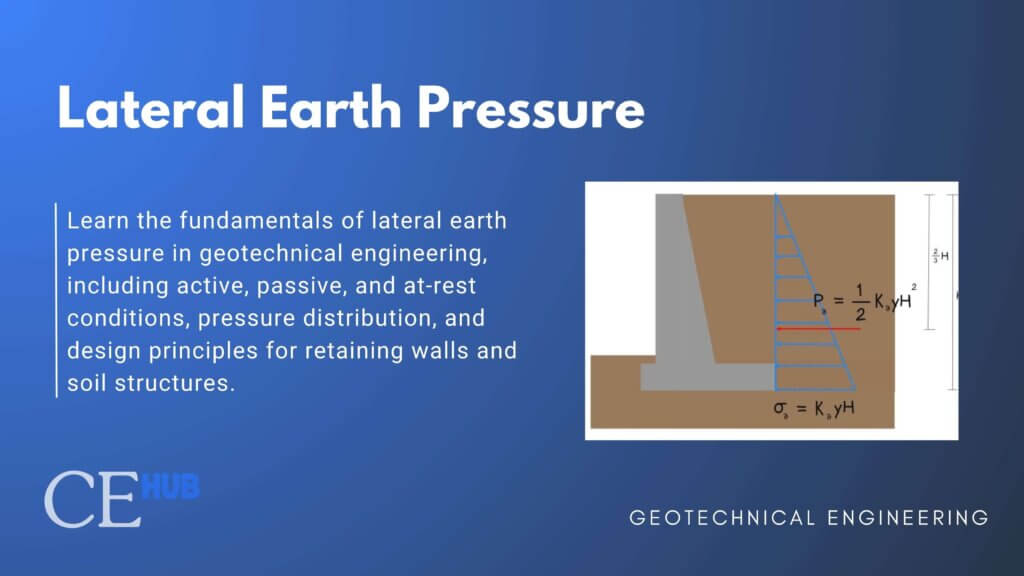
- Lateral earth pressure is the horizontal pressure exerted by soil against retaining structures.
- At-rest pressure (K₀): Pressure when the wall does not move.
- Active pressure (Ka): Pressure when the wall moves away from the soil, allowing soil to expand. Minimum lateral pressure.
- Passive pressure (Kp): Pressure when the wall is pushed into the soil, compressing it. Maximum lateral pressure.
- Rankine’s Theory: Assumes a frictionless wall and calculates earth pressures based on soil properties.
- Coulomb’s Theory: Considers wall friction and provides more accurate results for practical applications.
Chapter 8: Slope Stability
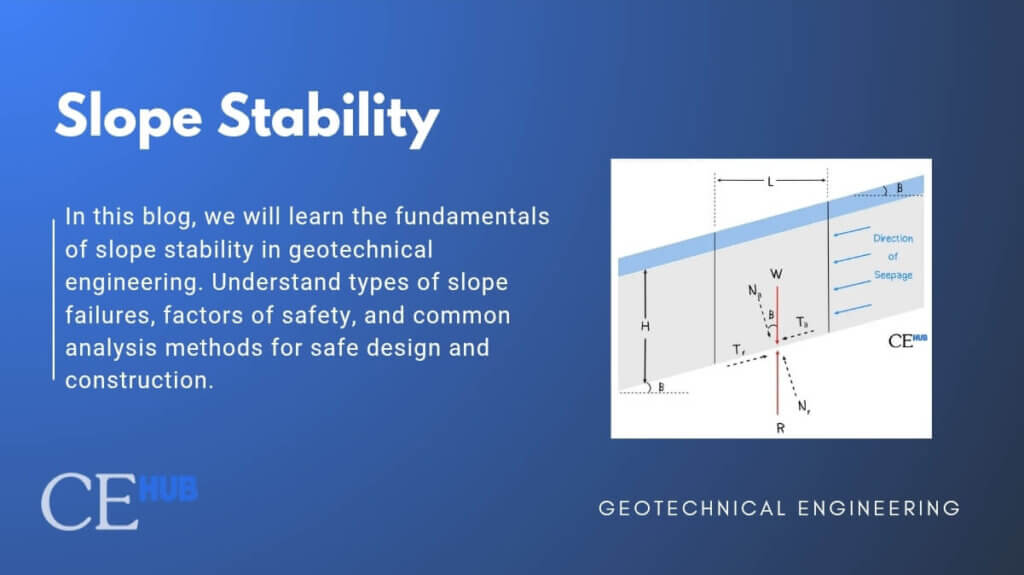
- Slope stability analysis determines whether a soil slope will remain stable or fail under given conditions.
- Types of slope failures: Rotational (circular), translational (planar), wedge, and flow failures.
- Factor of Safety (FS): Ratio of resisting forces (or moments) to driving forces (or moments)
Foundation Engineering
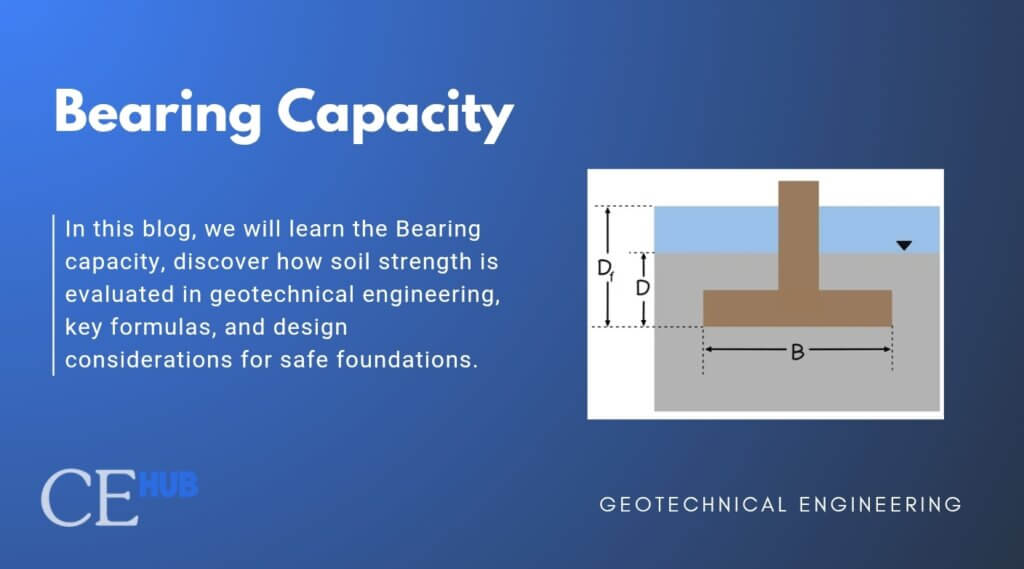
Ch9: Bearing Capacity
- Braced cuts are temporary excavations supported by bracing systems to prevent collapse.
- Lateral earth pressure in cuts: Uses apparent pressure diagrams (Peck’s diagrams) rather than classical earth pressure theories.
- Support systems: Soldier piles with lagging, sheet piles, and slurry walls with horizontal bracing (struts or wales).
- Strut loads: Calculated based on tributary area and apparent pressure distribution.
Ch10: Braced Cuts
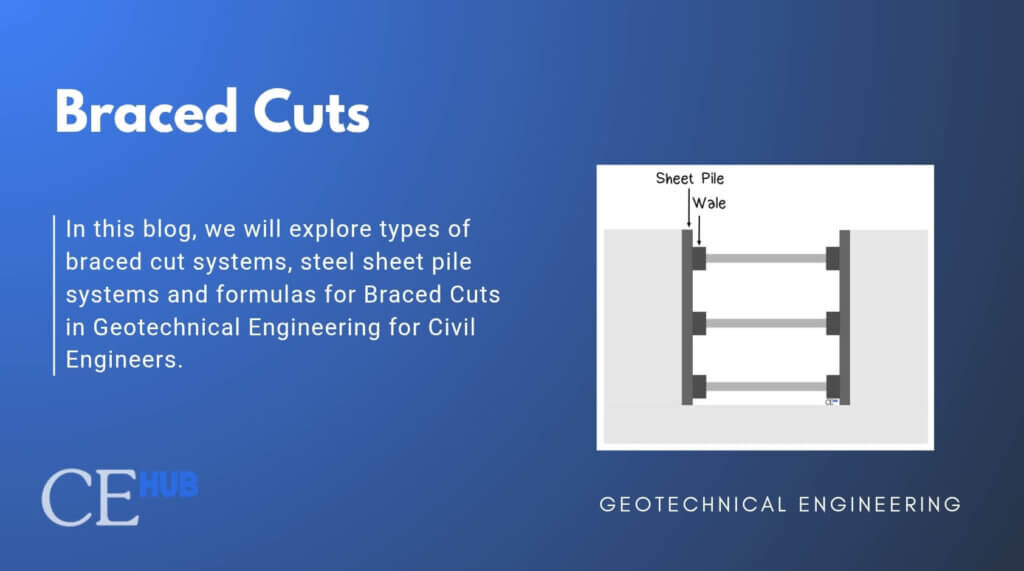
- Braced cuts are temporary excavations supported by bracing systems to prevent collapse.
- Lateral earth pressure in cuts: Uses apparent pressure diagrams (Peck’s diagrams) rather than classical earth pressure theories.
- Support systems: Soldier piles with lagging, sheet piles, and slurry walls with horizontal bracing (struts or wales).
- Strut loads: Calculated based on tributary area and apparent pressure distribution.
Ch11: Pile Capacity
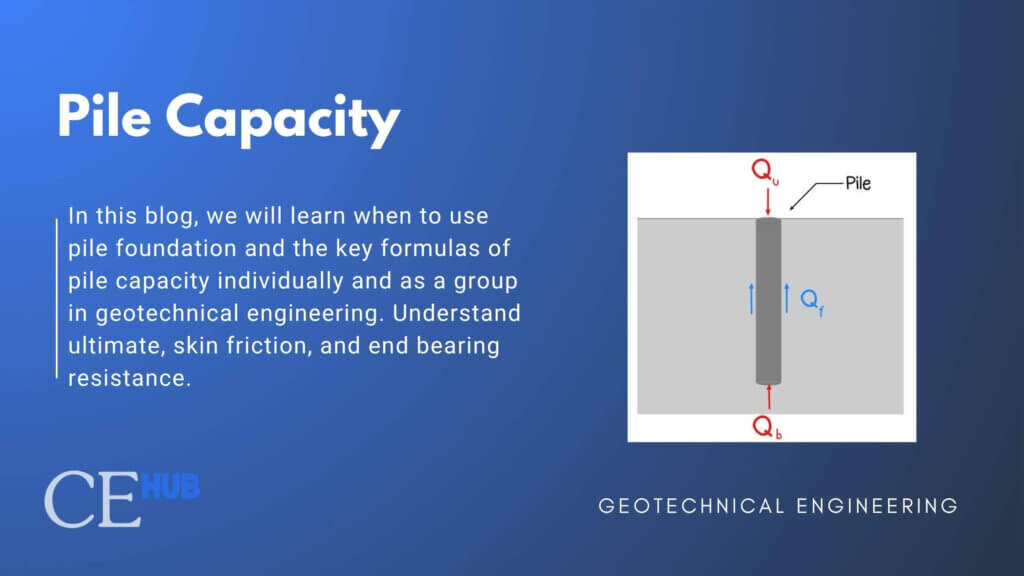
- Piles are deep foundation elements that transfer loads to deeper, stronger soil or rock layers.
- Types of piles: Driven piles, bored piles, cast-in-place piles, steel piles, concrete piles, timber piles.
- Pile capacity = Skin friction (shaft resistance) + End bearing (tip resistance)
- Group efficiency: Pile groups are less efficient than the sum of individual piles due to stress overlap.
Want to have the Complete Formula Cheat Sheet?
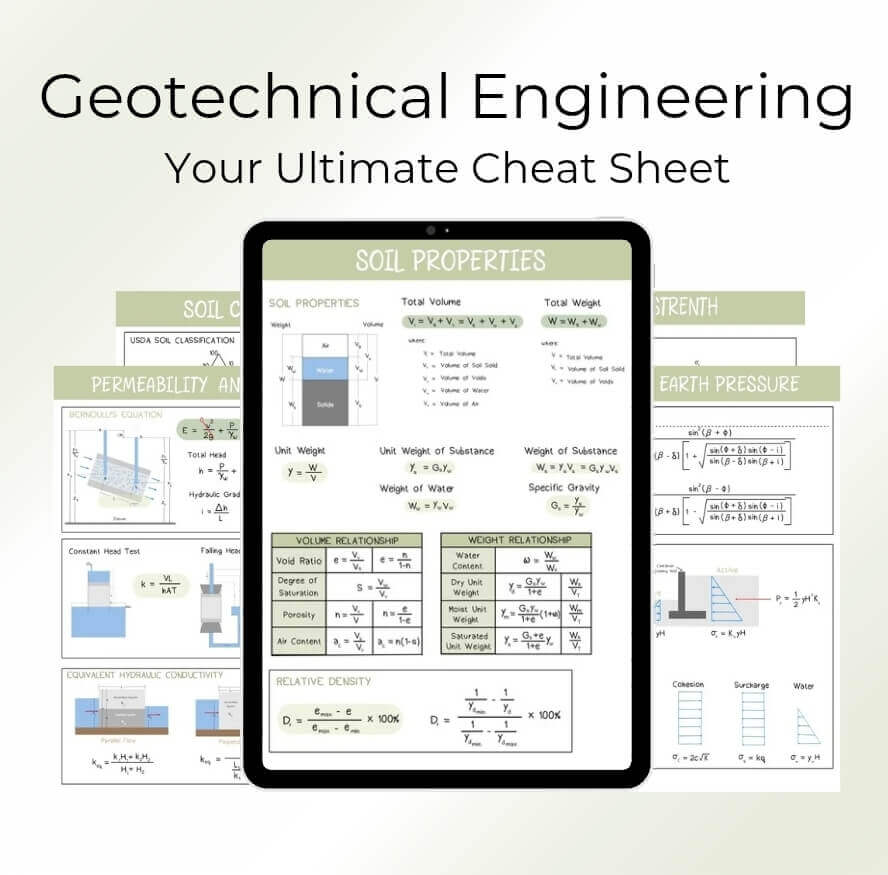
Geotechnical Engineering Cheat Sheet
Master the principles of soil mechanics with this comprehensive cheat sheet. Perfect for students and professionals!