Principles of Hydrostatic Pressure in Fluid Mechanics
What is Hydrostatic Pressure in Fluid Mechanics
Hydrostatic Pressure is the pressure exerted by a fluid at rest due to the force of gravity. It increases linearly with depth and acts equally in all directions at any given point in the fluid.
Hydrostatic pressure is significant especially in applications like dam analysis, hydraulic jump, and also lateral earth pressure in geotechnical engineering especially if there is a situation where near water source is involved.
Understanding Pressure in Fluids
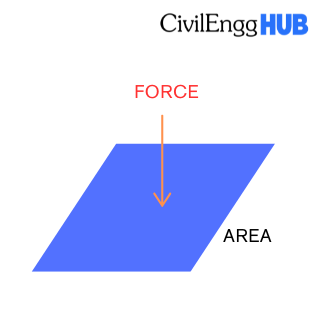
- Pressure is defined as the force exerted by a fluid per unit area.
![\[P=\frac{Force}{Area}=\frac{F}{A}\]](https://civilengghub.com/wp-content/ql-cache/quicklatex.com-8f64ef5b98a388e08ef265fd64a62ec1_l3.png "Rendered by QuickLaTeX.com")
Units of Pressure:
- 1 Pascal (Pa) = 1 N/m²
- 1 bar = Pa
- 1 atm = 101.325 kPa
- 1 atm = 14.7 psi
If the pressure distribution is non-uniform, it can be represented as the sum of differential pressures:
Hydrostatic Pressure
Hydrostatic pressure is the pressure exerted by a fluid at rest due to its weight. It increases with depth and is given by the formula:
![\[P=\rhogh\]](https://civilengghub.com/wp-content/ql-cache/quicklatex.com-2da22f78417156fb23d65857fa02aaa7_l3.png "Rendered by QuickLaTeX.com")
where:



Pressure Variation with Depth
The pressure at a point of a static homogenous fluid is the same in all directions.
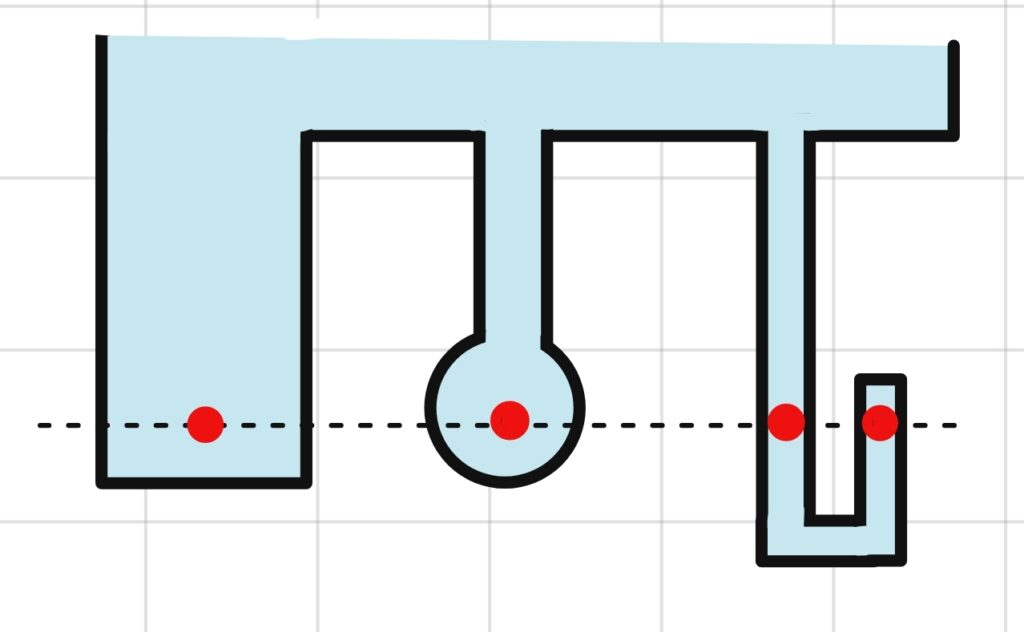
Also, pressure in a fluid increases with depth, thus, the formula is given by the hydrostatic pressure equation:

How do you calculate hydrostatic pressure vary with fluid density?
- Identify Fluid Density
- Measure depth: FInd the vertical distance (h) from free surface


Absolute, Atm and Gage Pressure
1. Atmospheric Pressure
is the pressure exerted by the atmosphere. It varies with altitude and weather conditions. At sea level, the standard atmospheric pressure is:
- 101.325 kPa (kilopascals)
- 1 atm (atmosphere)
- 760 mmHg (millimeters of mercury)
- 14.7 psi (pounds per square inch)
Take note: atmospheric pressure changes with elevation.
2. Absolute Pressure
Absolute pressure is measured relative to a perfect vacuum, meaning it includes atmospheric pressure. It is the true pressure within a system and is calculated as:
![\[ P_{abs}=P_{gauge}+P_{atm}\]](https://civilengghub.com/wp-content/ql-cache/quicklatex.com-c745fc6385dc16bea3824518ff1b6471_l3.png "Rendered by QuickLaTeX.com")
3. Gauge Pressure
Gauge pressure is the pressure measured relative to atmospheric pressure. It indicates the pressure above or below the atmospheric level. Gauge pressure can be positive or negative:
- Positive gauge pressure occurs when the measured pressure is above atmospheric pressure (e.g., in a pressurized tank).
- Negative gauge pressure (vacuum pressure) occurs when the measured pressure is below atmospheric pressure.
EXAMPLE 1.0
If a liquid has depth of 3 meters, and in this depth is a pressure of 20 kPa. What is the specific gravity of the liquid?



EXAMPLE 2.0
If the pressure point in the ocean is 120 kPa, what is the pressure 30 m below this point?

EXAMPLE 3.0
If the tank has an atmospheric pressure of 102.5 kPa, and the gage attached to the tank reads 256 mmHg vacuum. What is the absolute pressure within the tank?
References:
White, F. M. (2017). Fluid mechanics (7th ed.). Mcgraw-Hill Education.
Schaschke, C. J. (2015). Solved Practical Problems in Fluid Mechanics. CRC Press.
📍This post is part of FLUID MECHANICS COMPLETE Lessons. Also, if you want to avail the complete Cheat Sheet just click the “image” below.