Pile Capacity in Geotechnical Engineering
What are Piles and When to use them?
Piles are structural members made of steel, concrete, or timber that serve as deep foundations where the depth or length is significantly larger than the width. Unlike shallow foundations, deep foundations require special equipment and skilled labor, making them more expensive than conventional spread footings.
When are Pile Foundation recommended?
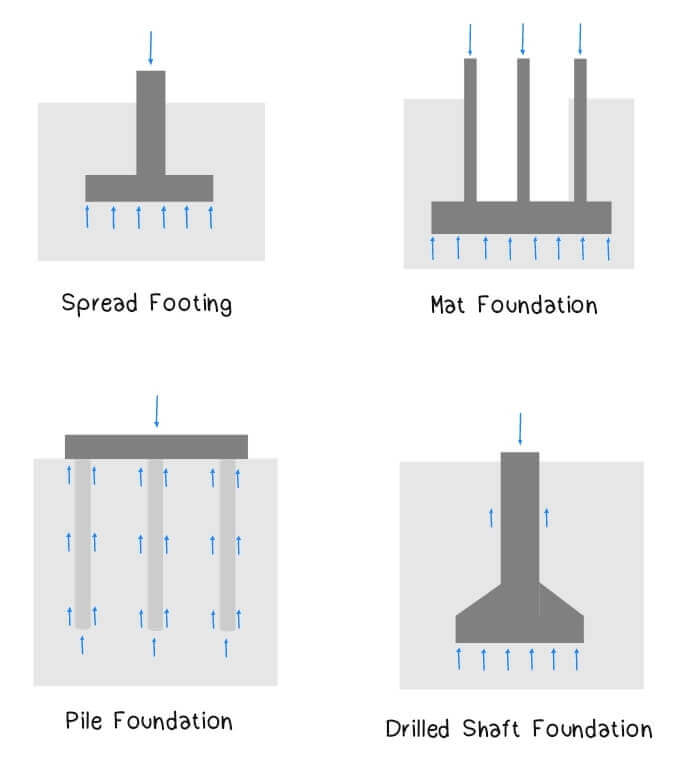
There are different types of foundation. Pile foundation should be considered when shallow foundations prove inadequate.
- Weak Ground Conditions
- Cannot withstand the heavy load from the structure
- Resisting Uplift
- Compaction Piles
Types of Pile Foundation
- Steel Pile
- Concrete Pile
What is Pile Capacity?
Pile capacity refers to the maximum load a pile can safely support without experiencing excessive settlement or structural failure. It encompasses two critical components:
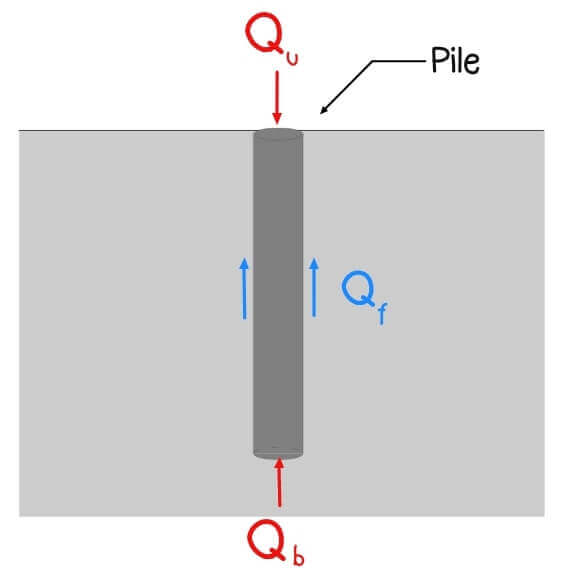
Ultimate Pile Capacity (Qu)
The maximum load the pile can sustain before failure occurs, combining both shaft resistance and end-bearing capacity.
The ultimate load carrying capacity (Qu) of a pile is given by the fundamental equation:
![\[Q_{u}=Q_{eb}+Q_{sf}\]](https://civilengghub.com/wp-content/ql-cache/quicklatex.com-f4652e121413567671f497e1a47b7df6_l3.png "Rendered by QuickLaTeX.com")
where:


Allowable Load Capacity (Qa)
The safe working load obtained by dividing the ultimate capacity by an appropriate factor of safety, typically ranging from 2.0 to 3.0.
The allowable load capacity provided a safety margin against failure:
![\[Q_{a}=\frac{Q_{u}}{FS}\]](https://civilengghub.com/wp-content/ql-cache/quicklatex.com-770c7dd270d3a5dab3c046a23cf6655d_l3.png "Rendered by QuickLaTeX.com")
where:

Component of Pile Capacity
1. Shaft Resistance (Skin Friction)
Shaft resistance develops along the embedded length of the pile through friction and adhesion between the pile surface and surrounding soil.
2. End Bearing Capacity
End bearing resistance occurs at the pile tip, where the load is transferred directly to the bearing stratum. This component becomes dominant when:
- Piles are driven to hard rock or dense soil layers
- The pile diameter is relatively large
- Using short, stubby piles
Piles on Sand
End-Bearing Capacity
![\[Q_{Eb}= \sigma' A_pN_q\]](https://civilengghub.com/wp-content/ql-cache/quicklatex.com-950be3836ea18691e5cbc4864638e005_l3.png "Rendered by QuickLaTeX.com")
where:



Skin Friction Resistance
![\[Q_{sk}=\mu p A_{p.diag}k\]](https://civilengghub.com/wp-content/ql-cache/quicklatex.com-3e39aa46a8e87248a243460454fc6631_l3.png "Rendered by QuickLaTeX.com")
where: 



Piles on Clay
![\[Q_{u}=Q_{eb}+Q{sk} \]](https://civilengghub.com/wp-content/ql-cache/quicklatex.com-0f6d8d6ec9b0f2347b3f6bd8a88b3d50_l3.png "Rendered by QuickLaTeX.com")
![\[Q_{eb}=cAN_c \]](https://civilengghub.com/wp-content/ql-cache/quicklatex.com-65e936d14627352dd90a1f791136c2a6_l3.png "Rendered by QuickLaTeX.com")
Alpha Method
The  method is widely used for cohesive soils in undrained conditions:
CLAP
![\[Q_{sk} = \sum (cL\alpha p) \]](https://civilengghub.com/wp-content/ql-cache/quicklatex.com-9efca4ab23ad4fbbe02ab6af2c1a2078_l3.png "Rendered by QuickLaTeX.com")
where: 



Beta Method
BLOP
![\[Q_{sk} = \sum (\beta L \sigma '_m p) \]](https://civilengghub.com/wp-content/ql-cache/quicklatex.com-48b457ed0070e73e65e37086fe35f0fa_l3.png "Rendered by QuickLaTeX.com")
where:




Lambda Method
![\[Q_sk = \sum \lambda L (\sigma_m' +2c)p \]](https://civilengghub.com/wp-content/ql-cache/quicklatex.com-20689e1a35904b5b621a07a723d38bf8_l3.png "Rendered by QuickLaTeX.com")
where:




Pile Act as a Block
When multiple piles are installed close together, they don’t simply act as independent load-bearing elements. Instead, the soil zone around and beneath the pile group becomes stressed as a single unit.
![\[Q_u=Q_{eb}+Q_{sf}\]](https://civilengghub.com/wp-content/ql-cache/quicklatex.com-e0ac2ed0b959f04d4209c7ae771e9ba8_l3.png "Rendered by QuickLaTeX.com")
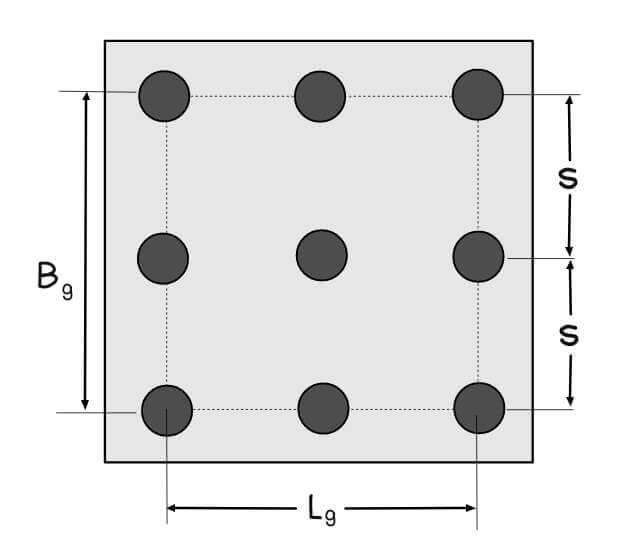
End Bearing Capacity
![\[Q_{eb}=CN_c(L_g \times B_g)\]](https://civilengghub.com/wp-content/ql-cache/quicklatex.com-ee8330229a8113c9b75e857a6fd8aefb_l3.png "Rendered by QuickLaTeX.com")
Skin Friction
![\[Q_{sf}=2 \alpha CL(L_g+B_g)\]](https://civilengghub.com/wp-content/ql-cache/quicklatex.com-34bf5cb8cea591d0bfc4fad2b015cf73_l3.png "Rendered by QuickLaTeX.com")
Group Efficiency
Converse-Labarre Equation
![\[E_g=1-\frac{\theta[(m-1)n+(n-1)m]}{90mn}\]](https://civilengghub.com/wp-content/ql-cache/quicklatex.com-d5fd706e8f6ba4fc87e4712c98f03652_l3.png "Rendered by QuickLaTeX.com")
Bowles Equation
![\[E_g=\frac{2(m+n-2)S+4D}{\pi Dmn}\]](https://civilengghub.com/wp-content/ql-cache/quicklatex.com-957cb3b8876d1adea102ba3abed8fc88_l3.png "Rendered by QuickLaTeX.com")
where:





References:
Das, B.M. (2007). Principles of Foundation Engineering (7th Edition). Global Engineering
Rajapakse, R. (2016). Pile Design and Construction Rule of Thumb (2nd Edition). Elsevier Inc.
Tomlinson, M.J. (2004). Pile Design and Construction Practice (4th Edition). E & FN Spon.